

Uncategorized
Cost per Meal: Freeze‑Dried vs. Raw Frozen vs. Kibble (EU Examples)
Mar
Cost per Meal: Freeze‑Dried vs. Raw Frozen vs. Kibble (EU Examples)
Wondering what you really pay per meal when choosing freeze‑dried, raw frozen, or kibble? You’re not alone. Price tags rarely tell the full story—especially when moisture and energy density differ.
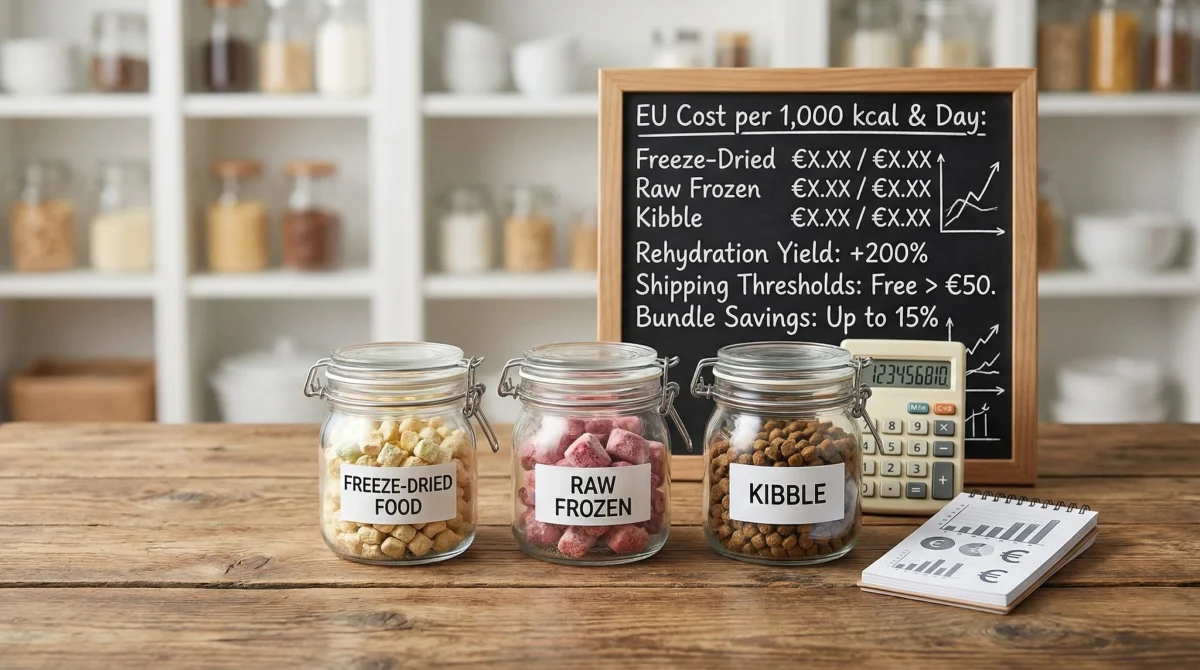
In this focused guide, the Good4Dogs team breaks down cost per 1,000 kcal and per‑day totals by dog size, showing rehydration yield, shipping thresholds, and bundle savings. Think of it as the practical, calculator‑backed side of “cost per meal freeze-dried dog food.”
How Cost per Meal Works: Methodology and Assumptions
Standardizing by energy: cost per 1,000 kcal
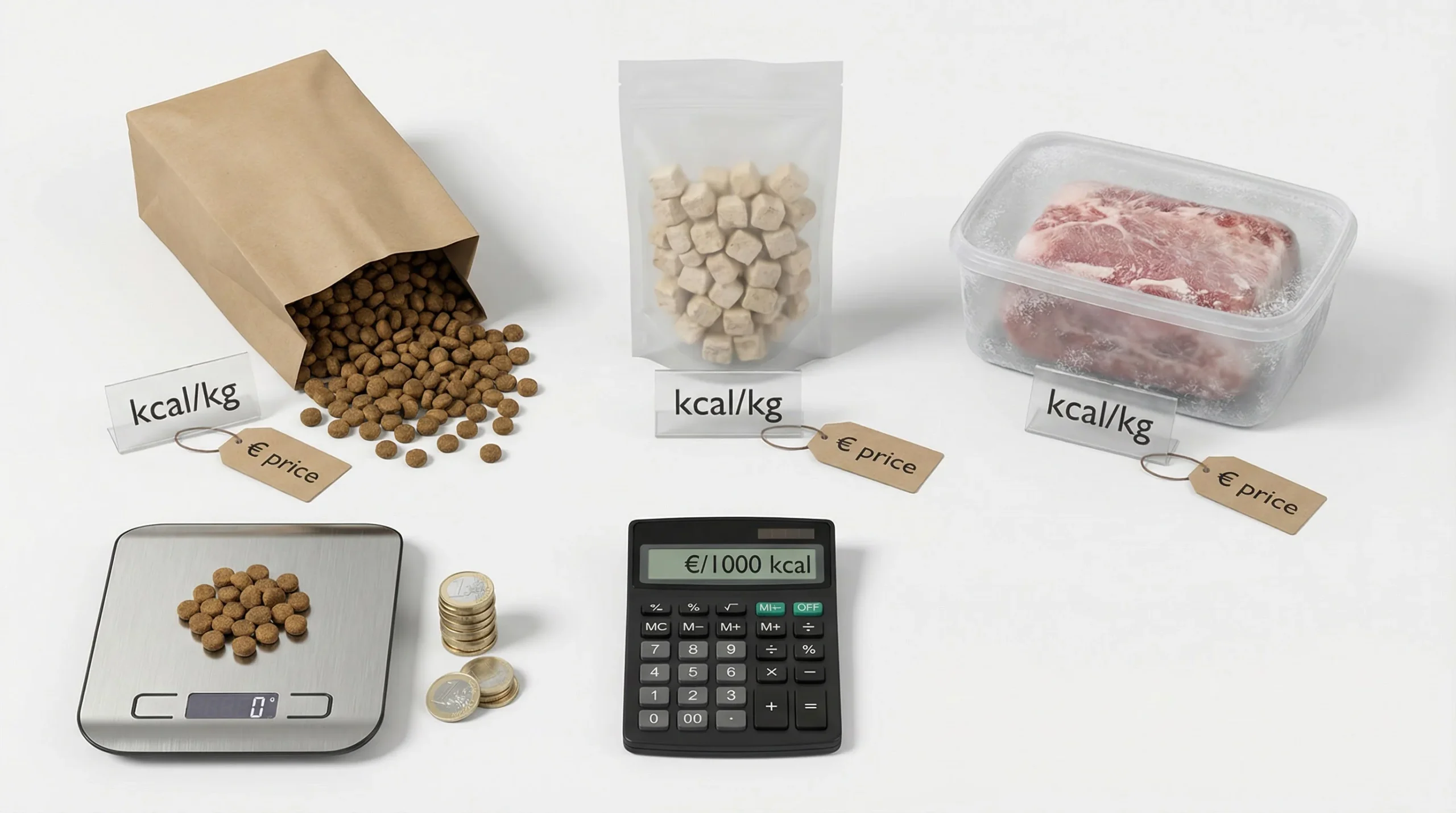
To compare formats fairly, convert every product to cost per 1,000 kcal: divide pack price by total kcal in the pack, then multiply by 1,000. This normalizes differences in moisture and density. For broader context, see the value and budgeting section of the main guide, which explains why energy-based comparisons are more reliable than price per kilogram alone. Research comparing dry and wet formats also emphasizes that cost assessments must consider energy yield, not just package weight.[2]
Daily cost by dog size and activity level
Once you have a cost per 1,000 kcal, estimate your dog’s daily energy need (kcal/day) based on size and activity. Multiply your dog’s kcal/day by the cost per kcal (i.e., cost per 1,000 kcal divided by 1,000). Studies consistently show that normalizing intake to energy improves cost accuracy across diet types.[1]
Rehydration ratios and edible yield assumptions
For freeze‑dried meals, use the rehydration ratio (typically 1:2 to 1:2.5 water by weight) to gauge wet serving size and satiety. Cost per kcal doesn’t change with water, but portion volume does—important for meal planning and consistency.
Freeze‑Dried vs. Raw Frozen vs. Kibble: Core Differences That Impact Cost
Moisture and energy density
Freeze‑dried is very energy‑dense, because most water is removed. Raw frozen contains high moisture, lowering kcal per kilogram. Kibble sits in between. These differences explain why “price per kg” can mislead; energy normalization is essential.[2]
Storage, spoilage, and waste considerations
Raw frozen often requires freezer space, and partial thawing can increase spoilage risk. Kibble is shelf‑stable but can stale if stored improperly. Freeze‑dried minimizes waste with long shelf life, which can narrow practical cost gaps in everyday use.
Convenience factors that change real‑world cost
Travel, boarding, and small kitchens make logistics matter. Freeze‑dried’s light weight reduces shipping and transport costs per kcal. These “hidden” savings aren’t always on the label but affect your total monthly outlay in the real world.
EU Price Benchmarks: Typical Ranges per 1,000 kcal
Freeze‑dried (premium, single‑protein examples)
Indicative EU range: ~€6–€12 per 1,000 kcal for complete, premium freeze‑dried meals. Single‑protein options may skew higher due to sourcing. For format comparisons beyond cost, see freeze‑dried vs. air‑dried vs. kibble nutrient preservation.
Raw frozen (BARF chub/patty formats)
Indicative EU range: ~€2–€5 per 1,000 kcal, depending on protein and producer scale. “Raw frozen dog food price EU” varies widely by region and seasonal sourcing.
Kibble (grain‑free vs. standard)
Indicative EU range for “kibble cost per 1000 kcal”: ~€1.5–€3 (standard) and ~€3–€6 (grain‑free/high‑meat). Dry diets frequently deliver lower cost per energy than wet styles.[3]
| Format | Typical kcal/kg | Indicative € per 1,000 kcal |
|---|---|---|
| Freeze‑dried (complete) | 4,000–5,500 | €6–€12 |
| Raw frozen (BARF) | 1,600–2,500 | €2–€5 |
| Kibble (standard → grain‑free) | 3,200–4,200 | €1.5–€6 |
Per‑Day Examples by Dog Size (Toy, Medium, Large) with Calculator Notes
Toy (4–6 kg) daily cost scenarios
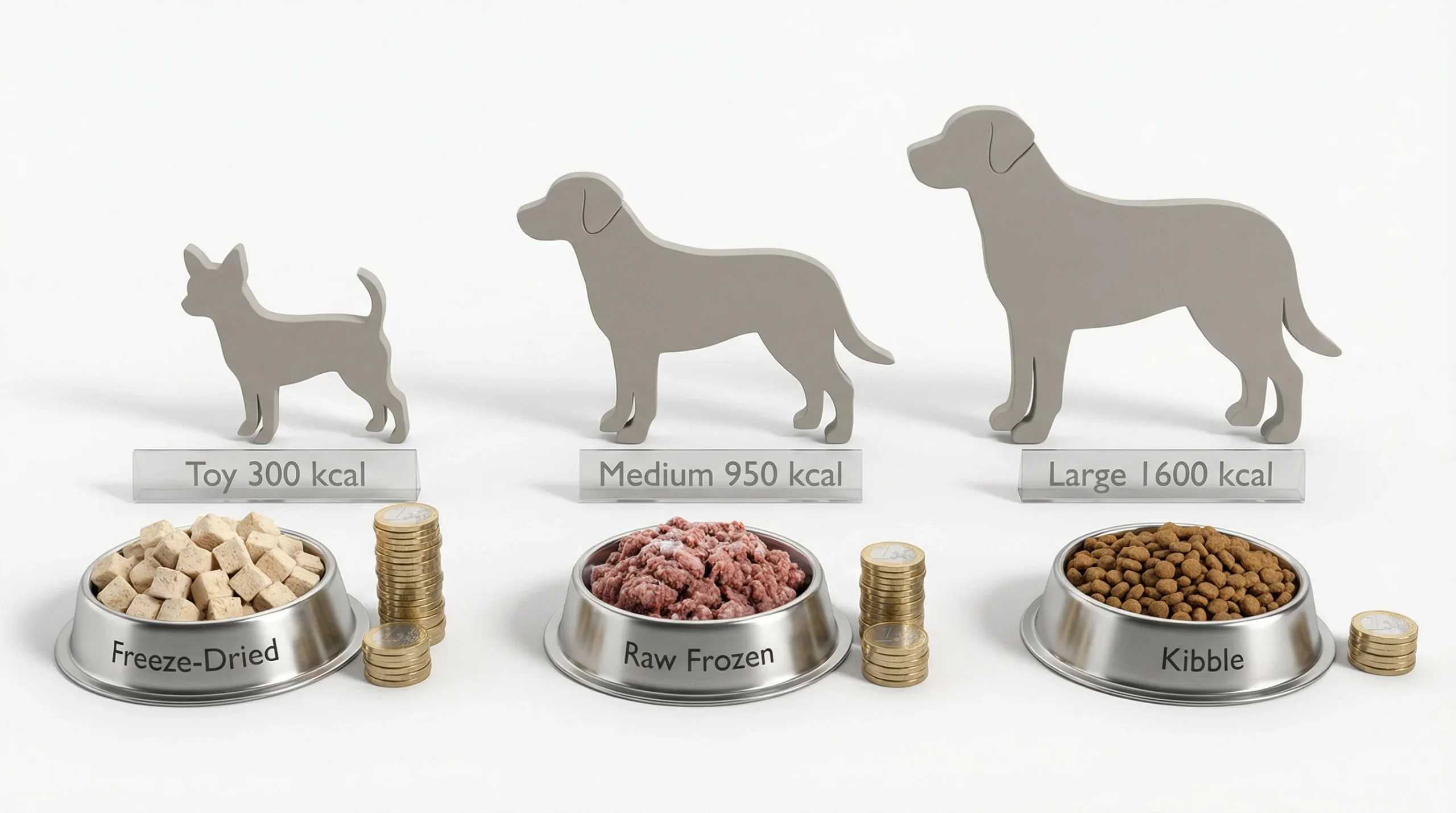
Assume 300 kcal/day. Example costs: Freeze‑dried at €8/1,000 kcal ≈ €2.40/day; Raw frozen at €3.5/1,000 kcal ≈ €1.05/day; Kibble at €2.5/1,000 kcal ≈ €0.75/day. These are energy‑normalized, not wet-weight based—handy for honest comparisons. Use our feeding calculator to personalize costs.
Medium (18–22 kg) daily cost scenarios
Assume 950 kcal/day. Freeze‑dried at €8/1,000 kcal ≈ €7.60/day; Raw frozen at €3.5/1,000 kcal ≈ €3.33/day; Kibble at €2.5/1,000 kcal ≈ €2.38/day. Real‑world totals may drop if bundles or free shipping apply. Try the feeding calculator to personalize costs.
Large (30–35 kg) daily cost scenarios
Assume 1,400 kcal/day. Freeze‑dried at €8/1,000 kcal ≈ €11.20/day; Raw frozen at €3.5/1,000 kcal ≈ €4.90/day; Kibble at €2.5/1,000 kcal ≈ €3.50/day. Storage capacity can shift the best value. Use the feeding calculator to personalize costs.
Using a feeding calculator to personalize cost
Every dog differs. Input weight, age, and activity to refine daily kcal, then convert your brand’s price into € per 1,000 kcal. A “dog food cost calculator EU” approach helps align budget with performance.[1]
Rehydration Yield and Portioning: How Much Food Does 100 g Make?
Typical freeze‑dried rehydration ratios (1:2 to 1:2.5 water)
Most complete freeze‑dried recipes use a 1:2 to 1:2.5 ratio by weight. So, 100 g dry + 200–250 g water ≈ 300–350 g wet. Check your label; formats vary. For guidance, see our freeze‑dried product education page.
Comparing wet weight after rehydration vs. raw frozen
Rehydrated freeze‑dried portions often resemble raw frozen servings in wet weight and texture. The difference is logistics: freeze‑dried stores pantry‑stable, while raw frozen needs freezer space and defrost planning, influencing convenience value.
Cost implications of incorrect water ratios
Adding too much water can create the impression of a larger meal, but energy per bowl won’t change. Maintain consistent ratios so daily kcal—and therefore daily cost—remain stable and predictable for your budget.
For families transitioning to raw with simple portioning, many find Everfresh Freez-Dried food – Beef 500g helpful for this task.
Shipping Thresholds, Storage and Bundle Savings in the EU
Free‑shipping thresholds that change effective price per kcal
Crossing a free‑shipping threshold can reduce the effective price per 1,000 kcal, especially for weighty raw frozen or bulk kibble. Plan order cadence: fewer, larger orders often beat frequent small top‑ups in delivery‑heavy regions.
Pantry footprint: grams per meal and travel logistics
Freeze‑dried’s low mass means more meals per kilogram shipped, plus easier travel packing. This can offset a higher shelf price with lower delivery, storage, and waste overhead for apartments or frequent travelers.
Bundle structures that reduce cost per day
Look for multi‑pack or subscribe‑and‑save structures that reduce average cost per kcal. Retailers may design retail packaging and bundles that drive AOV, effectively lowering your per‑day cost when you plan ahead monthly.
When Each Format Wins: Scenario‑Based Guidance
Budget‑first households
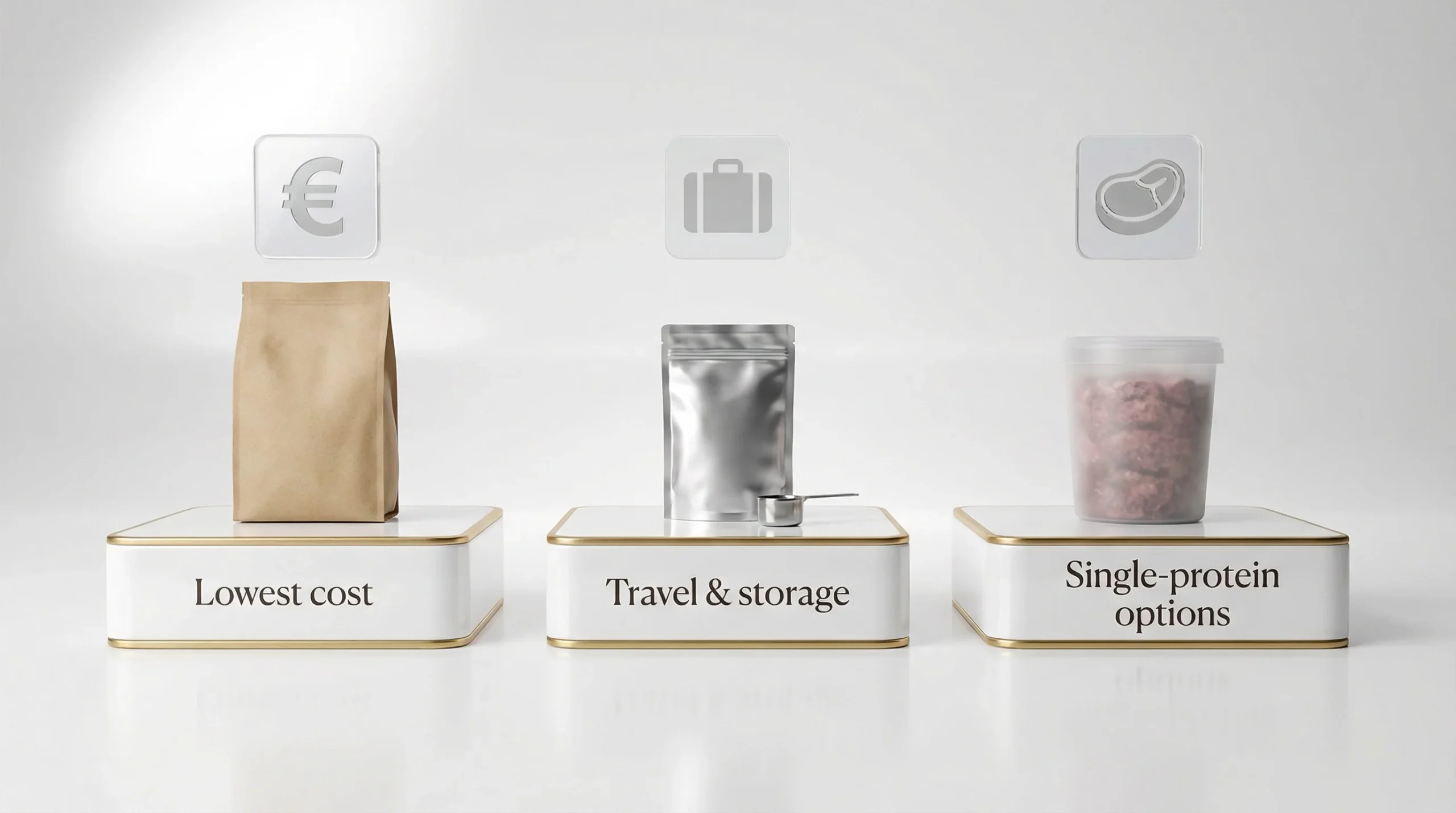
If your priority is the lowest cost per kcal, standard kibble usually wins. Dry commercial diets are consistently more economical per energy unit than wet or fresh formats across analyses.[2][3]
Allergy management and single‑protein choices
For specific proteins or simplified ingredient decks, freeze‑dried and raw frozen offer many single‑protein options. This can increase cost per kcal but may reduce vet visits or diet trials—an important long‑term value consideration.
Active lifestyles, travel and limited freezer space
When portability matters, freeze‑dried shines: it’s light, compact, and rehydrates quickly. The convenience may justify a higher energy‑normalized price, especially if it reduces waste and improves feeding consistency on the go.
Data Inputs: How to Gather Prices and Validate Your Calculation
Where to find kcal per kg and moisture data on labels
Look for “metabolizable energy” (ME) or kcal/kg on the label or product page. Moisture percentage helps you understand density and how rehydration affects bowl weight, not energy. Energy‑based comparisons improve accuracy.[2]
Converting pack prices to cost per 1,000 kcal
Use this quick method:
- Find pack price and total kcal in the pack (weight × kcal/kg).
- Divide price by total kcal for €/kcal.
- Multiply by 1,000 to get €/1,000 kcal for clean comparisons.
Takeaway: Normalizing by energy is the fairest way to compare freeze‑dried vs raw dog food cost across brands and formats.
Cross‑checking with a feeding calculator
Run a calculator to estimate daily kcal needs, then multiply by your €/kcal figure for a per‑day total. Optimization approaches—whether basic spreadsheets or advanced models—can refine choices for budget targets.[4]
Frequently Asked Questions
How do I compare dog food prices fairly across formats?
Normalize by energy. Convert each product to cost per 1,000 kcal using label kcal/kg. Then estimate your dog’s daily kcal need to get per‑day cost.
What rehydration ratio should I use for freeze‑dried food?
Most freeze‑dried complete meals use roughly 1 part food to 2–2.5 parts water by weight. Follow the brand’s guidance and adjust to your dog’s preferred texture.
Is freeze‑dried always more expensive than kibble?
Typically yes on a per‑kcal basis, but effective cost can narrow with bundle savings, reduced waste, and lower storage/logistics costs for some households.
Do shipping thresholds really change my cost per meal?
They can. Crossing free‑shipping thresholds or planning larger, less frequent orders can lower your effective cost per 1,000 kcal, especially for bulky formats.
How accurate are daily cost estimates by dog size?
They’re estimates. Actual needs vary by age, body condition, and activity. Use a feeding calculator and monitor weight to refine daily intake and cost.
Conclusion
When you standardize dog diets by energy, cost comparisons become clear and fair. Freeze‑dried excels in convenience and low waste, raw frozen leverages value with freezer space, and kibble delivers the lowest €/kcal for many budgets. Combine energy‑based math with rehydration ratios, shipping thresholds, and bundle planning to reveal your real monthly spend. With a simple calculator and a few label reads, you’ll pinpoint the best balance of nutrition, practicality, and cost for your household. If you’re moving between formats, keep portions energy‑consistent, watch body condition, and revisit calculations seasonally as activity and prices shift. Friendly math, happier meals.
References
- THA Vendramini et al. (2020). Homemade versus extruded and wet commercial diets for dogs: Cost comparison. PLoS …. View article
- THA Vendramini et al. (2024). What is the cost of weight loss? An approach to commercial (dry and wet) and homemade diets. Animals. View article
- GR Kratzer et al. (2022). Home-cooked diets cost more than commercially prepared dry kibble diets for dogs with chronic enteropathies. Journal of the …. View article
- HAO Joban et al. (2020). Cost optimization of homemade diet for dogs. International Journal of Applied …. View article