

Uncategorized
Freeze‑Dried Feeding Calculator: Rehydration, Portions, and Calories per Day
Mar
Freeze‑Dried Feeding Calculator: Rehydration, Portions, and Calories per Day
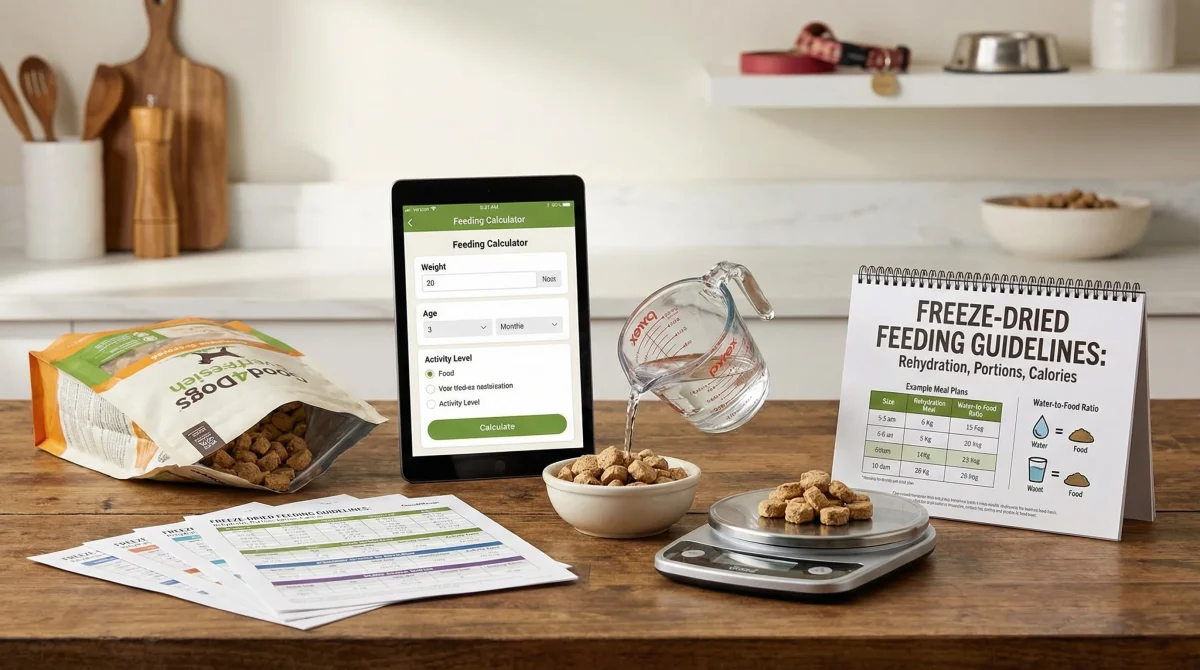
Ready to turn your dog’s weight and routine into precise, confidence-boosting meals? This focused guide shows you exactly how to use a freeze‑dried feeding calculator to translate energy needs into dry grams, water, and daily portions—without guesswork.
We’ll walk through MER calculations by weight, age, and activity; the rehydration ratio for freeze‑dried dog food; and practical Everfresh meal plans you can print and use today. Let’s make feeding simple, nourishing, and consistent.
How the Freeze‑Dried Feeding Calculator Works
Our calculator is built to be practical: it converts your dog’s maintenance energy into freeze‑dried dog food portions and water for rehydration. If you’re new to animal‑based nutrition and want the big‑picture first, see our pillar guide after this section: it covers formats, sourcing, and transition tips so you’ll feel fully prepared to use the calculator results with confidence. The calculator also doubles as a dog calorie calculator by weight—handy if you’re tracking adjustments weekly.
Inputs: weight, age/life stage, body condition, activity level
Enter your dog’s current weight (kg), life stage (puppy, adult, senior), body condition (lean, ideal, overweight), and daily activity (low, moderate, high). These inputs set your energy target and the Good4Dogs Everfresh feeding guide multipliers that tailor meals for growth, maintenance, or weight change.
Outputs: dry grams, rehydrated grams, total kcal/day, meals/day
You’ll receive four numbers: total kcal/day (MER), dry grams/day based on your recipe’s kcal per 100 g, recommended water to add (ml), and a suggestion to split into 1–3 meals/day. You can also factor snacks to keep totals accurate.
Animal‑Based Pet Nutrition for Dogs: The Complete Guide to Freeze‑Dried, Raw, and Functional Feeding expands the “why” behind each input so you can fine‑tune for your dog’s lifestyle.
Step‑by‑Step: Calculate Daily Energy Needs (MER)
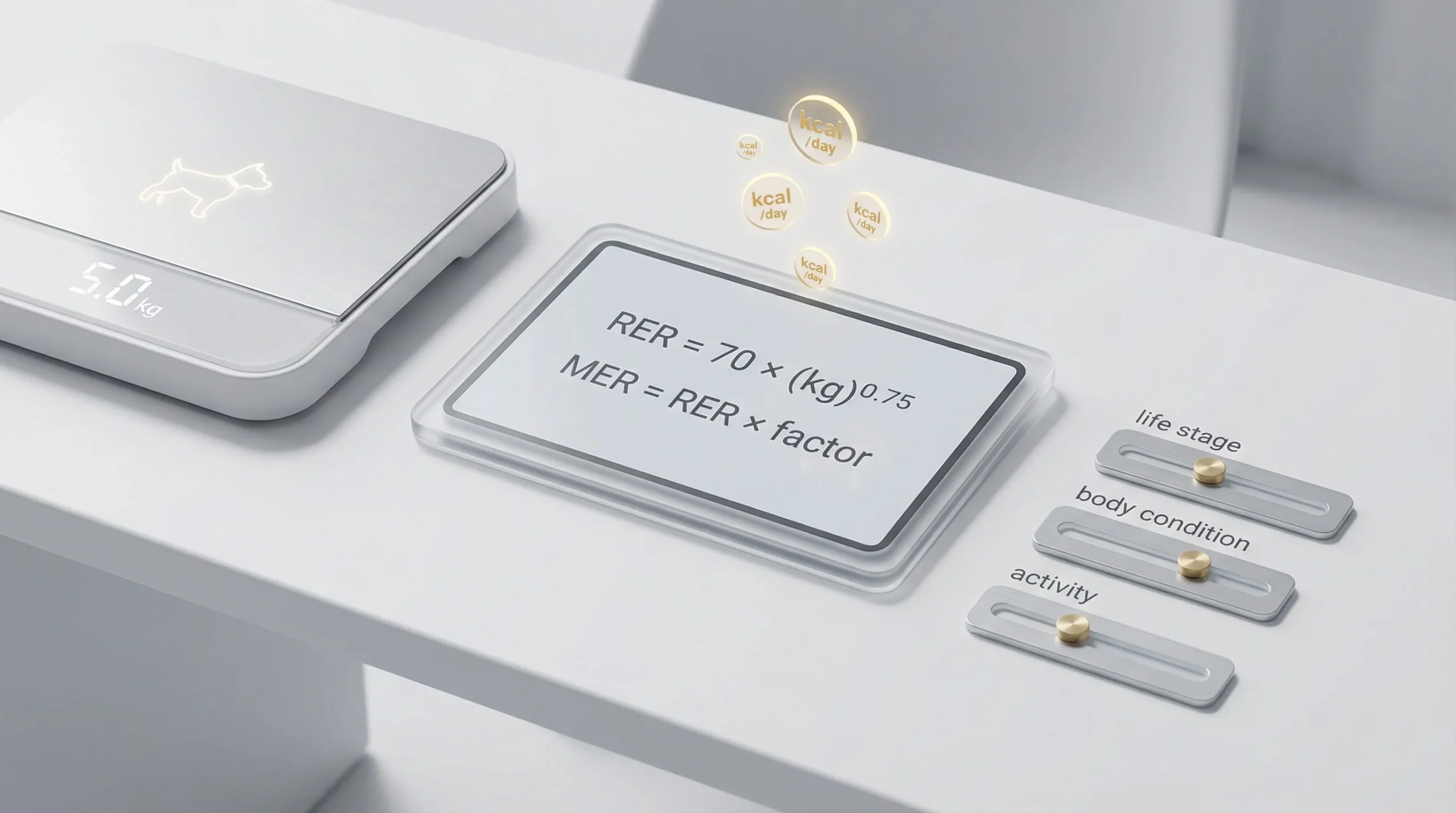
Use RER = 70 × (BWkg^0.75), then adjust by activity multipliers
Start with Resting Energy Requirement (RER): RER = 70 × (body weight in kg)^0.75. Then multiply by a life‑stage/activity factor (MER). Typical multipliers: 1.2–1.6 for adults, 1.6–2.0+ for active adults, ~1.0 for weight loss, and 2.0–3.0 for puppies.
Life‑stage modifiers: puppy, adult, senior, weight loss/gain
Puppies require higher MER (age‑dependent). Adults vary by condition and exercise; seniors may sit slightly lower unless very active. For weight loss, use 0.8–1.0× RER; for weight gain, 1.2–1.4×. Reassess weekly using body condition.
Worked examples: 5 kg companion, 20 kg active adult, 30 kg weight loss
5 kg adult (moderate): RER ≈ 234 kcal; MER ~1.4× ⇒ ~328 kcal/day. 20 kg active: RER ≈ 662; MER ~1.8× ⇒ ~1,192 kcal/day. 30 kg weight loss: RER ≈ 897; MER ~1.0× ⇒ ~897 kcal/day.
Freeze‑dried raw diets often deliver high amino acid digestibility and robust metabolizable energy, supporting accurate MER‑to‑grams conversions when you know your recipe’s kcal/100 g[1][2].
Portions: Converting Calories to Freeze‑Dried Grams
Find kcal per 100 g for Everfresh recipes and compute dry grams
Check your Everfresh label for kcal per 100 g (example: 500 kcal/100 g = 5 kcal/g). Dry grams/day = MER ÷ (kcal/g). For the 5 kg example (328 kcal) at 5 kcal/g, feed ~66 g dry/day. Always adjust with real label values.
Split into meals: 1–3 meals/day and snack adjustments
Divide daily dry grams into 1–3 meals to suit routine. If you use treats, subtract their calories from the daily MER before you portion meals. Keep snack calories ≤10% of daily intake for balance and stool stability.
Precision tips: rounding, scales, and consistency checks
Use a digital gram scale; round to the nearest 2–5 g for convenience. Re‑weigh weekly and recalibrate MER if body condition shifts. Because freeze‑dried raw is highly digestible, small gram changes can matter[1].
Takeaway: Accurate kcal/100 g + a kitchen scale = confident, repeatable portions that match your dog’s needs.
Rehydration: Exact Water‑to‑Food Ratios
Standard ratio (e.g., 1 part food : 2–3 parts water) and when to adjust
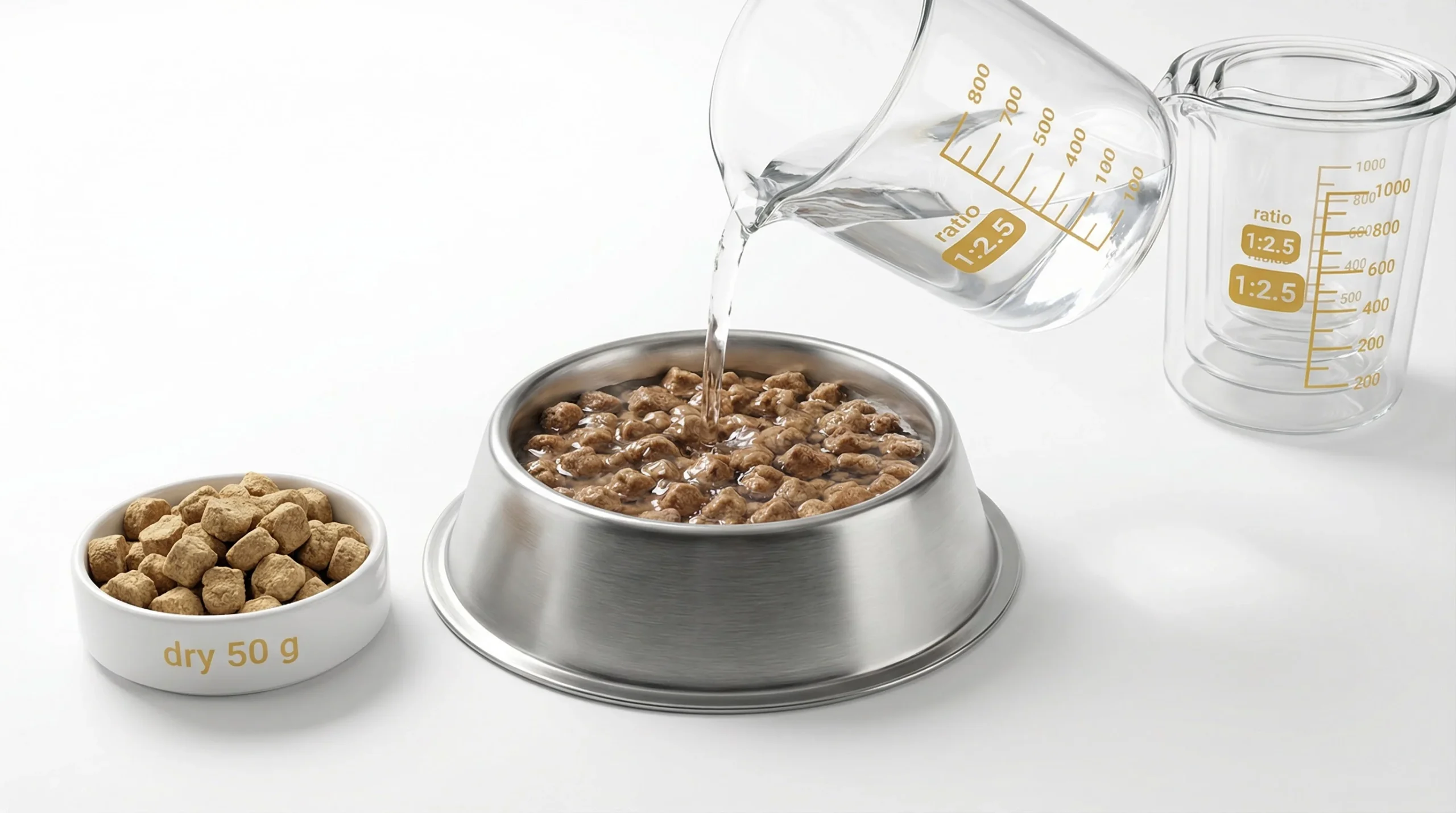
The standard rehydration ratio for freeze‑dried dog food is 1 part dry food to 2–3 parts warm water by volume. Start at 1:2.5, then fine‑tune based on your dog’s stool quality, appetite, and season.
Hydration for sensitive digestion, hot weather, and picky eaters
For sensitive digestion or hot weather, push toward 1:3 to support hydration. Picky eaters may prefer a warmer, gravy‑like mix. Slightly more water can slow eating in gulpers and improve post‑meal comfort.
Texture targets: pâté vs. chunky and soaking time
Pâté texture: 1:3 ratio, 3–5 minutes soak. Chunkier: 1:2 with a light fold of water. Add a splash at serving to adjust. Rehydration improves palatability and leverages the bioavailability observed in raw formats[2].
Note: Planning meals for hikes or boarding? See our travel feeding and packing tips for on‑the‑go portioning and water planning.
Example Meal Plans Using Good4Dogs Everfresh
Daily plan for small, medium, large dogs (dry grams + water ml + kcal)
Using a sample 500 kcal/100 g baseline (confirm your pack’s exact value), here’s how portions convert from our examples with a 1:2.5 food‑to‑water ratio:
| Dog | MER (kcal) | Dry (g) | Water (ml) | Rehydrated (≈g) |
|---|---|---|---|---|
| Small (5 kg adult) | ~330 | ~66 | ~165 | ~231 |
| Medium (20 kg active) | ~1,190 | ~238 | ~595 | ~833 |
| Large (30 kg weight loss) | ~895 | ~179 | ~448 | ~627 |
For Beef‑based days, many pet owners find Everfresh Freez-Dried food – Beef 500g helpful for this task.
Hypoallergenic scenario with horse recipe (Everfresh Horse)
For a 15 kg adult at ~1.4× RER (~746 kcal/day) and an assumed 450 kcal/100 g recipe, feed ~166 g dry/day with ~415 ml water. If using a novel protein elimination plan, see Hypoallergenic Proteins in Practice: When to Choose Horse and Other Novel Meats.
Printable 7‑day rotation template and batch prep
Rotating proteins supports variety in a BARF freeze‑dried meal planning context. Print and fill this weekly grid, then batch‑portion into airtight containers:
| Day | Recipe | Dry (g) | Water (ml) | Meals |
|---|---|---|---|---|
| Mon | Beef | — | — | 2 |
| Tue | Horse | — | — | 2 |
| Wed | Beef | — | — | 2 |
| Thu | Other | — | — | 2 |
| Fri | Beef | — | — | 2 |
| Sat | Horse | — | — | 2 |
| Sun | Beef/Other | — | — | 2 |
Budgeting and Monthly Planning
Calculate bags per month from daily dry grams
Multiply daily dry grams by 30 to estimate monthly dry total. Divide by your bag size to get required bags. Example: 150 g/day ≈ 4.5 kg/month; with 500 g bags, plan for ~9 bags monthly.
Factor treats and supplements without overfeeding
Keep treats ≤10% of daily calories. If using functional add‑ons (e.g., fish oil, green‑lipped mussel), account for their calories and subtract from meal grams. Recheck your dog’s body condition every 1–2 weeks.
See cost per meal with real‑world examples
To compare feeding scenarios and portions across budgets, explore cost per meal with real‑world examples. It pairs neatly with this calculator so you can plan nutrition and spending together.
Quality and Safety Notes for Freeze‑Dried Feeding
Handling and storage: moisture control and shelf life
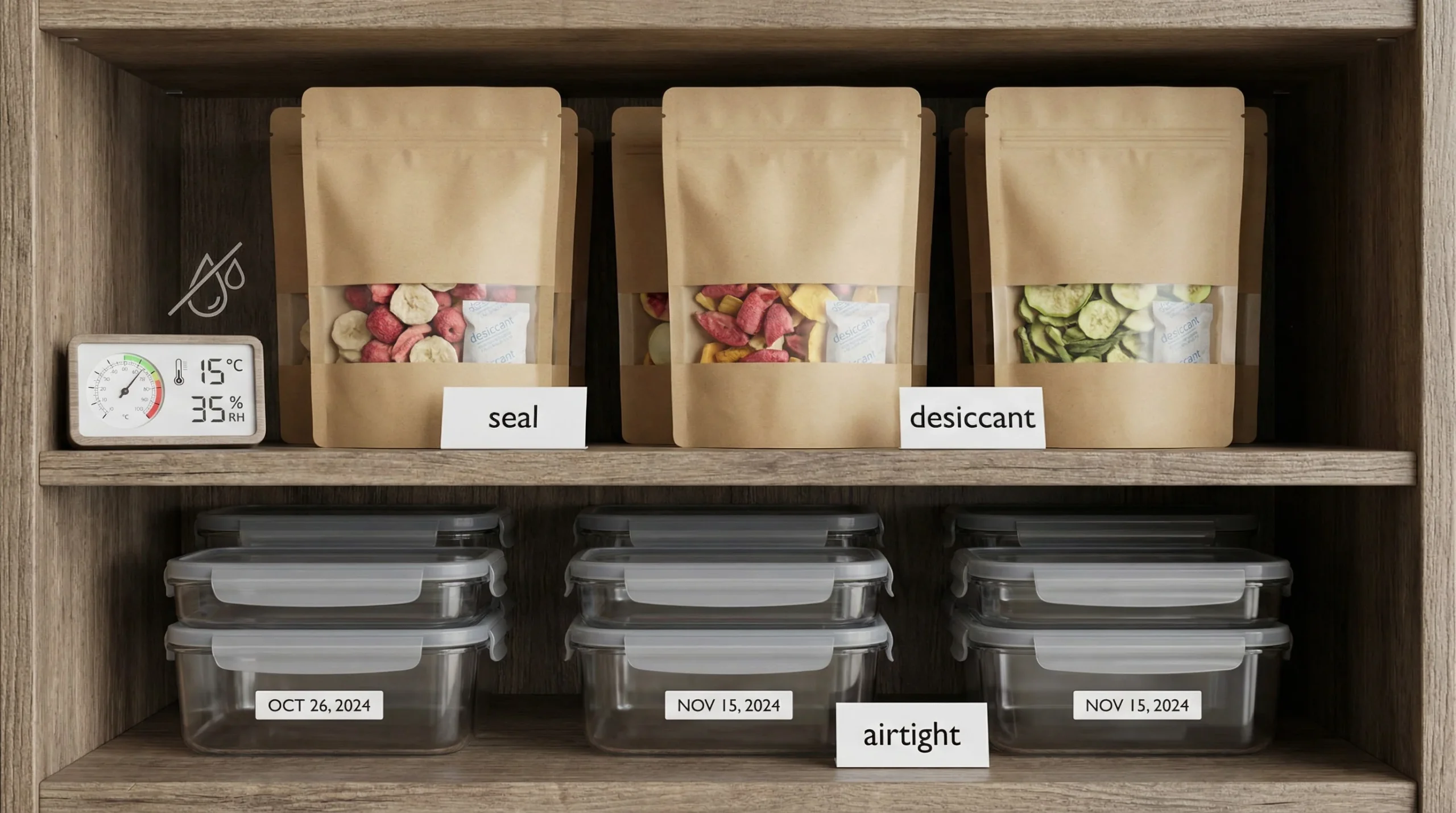
Keep bags sealed, use desiccants, and store in a cool, dry cupboard. After opening, portion into airtight containers to avoid humidity. For ingredient transparency and EU compliance, see EU Pet Food Labeling, Safety, and Sourcing: A Buyer’s Checklist and learn more about processing in Freeze‑Dried vs. Air‑Dried vs. Kibble: What Preserves Animal Nutrients Best?
Transition schedule from kibble/wet to freeze‑dried raw
Switch gradually over 5–7 days, increasing freeze‑dried while reducing the previous food. Monitor stool and appetite, and extend if needed. A day‑by‑day plan is outlined in Switching to Freeze‑Dried Raw: A 7‑Day Transition Plan for Dogs.
When to consult a vet or nutritionist
Discuss feeding changes for puppies, seniors, or dogs with medical conditions. Because processing affects digestibility and metabolizable energy, individualized oversight ensures accuracy as diets change[3][4].
Printable Charts and Quick Reference Tables
Weight‑based daily gram chart (dry and rehydrated)
Adult baseline: MER ~1.4× RER and recipe at 500 kcal/100 g (5 kcal/g). Rehydrate at 1:2.5 (food:water) for a spoonable texture.
| Weight (kg) | MER (kcal) | Dry (g) | Water (ml) | Rehydrated (≈g) |
|---|---|---|---|---|
| 5 | ~330 | ~66 | ~165 | ~231 |
| 10 | ~550 | ~110 | ~275 | ~385 |
| 15 | ~746 | ~149 | ~373 | ~522 |
| 20 | ~927 | ~185 | ~463 | ~648 |
| 25 | ~1,096 | ~219 | ~548 | ~767 |
| 30 | ~1,256 | ~251 | ~628 | ~879 |
Puppy growth stage multipliers and feeding frequency
| Age | Multiplier (vs. RER) | Meals/Day |
|---|---|---|
| 8–16 weeks | 2.5–3.0× | 3–4 |
| 4–9 months | 2.0–2.5× | 3 |
| 9–12+ months | 1.6–2.0× | 2–3 |
Use your recipe’s real kcal/100 g. Adjust weekly based on growth rate and stool quality.
Troubleshooting: signs to adjust portions or water
- Portions: rib cover too thick or thin, rapid weight change, low energy, or ravenous behavior.
- Water: overly firm stools (add more), watery stools (reduce, extend soak), or gulping (thicken texture).
- Reassess activity multipliers after seasonal or routine shifts.
Frequently Asked Questions
How much freeze‑dried dog food should my dog eat per day?
Estimate maintenance energy (MER) from weight and activity, then divide by the food’s kcal per gram to get dry grams. Most dogs eat 1–3 meals/day; adjust weekly based on body condition.
What is the best water‑to‑food ratio for rehydrating freeze‑dried meals?
A common starting point is 1 part food to 2–3 parts warm water by volume. Adjust to your dog’s preference and season; aim for a soft, spoonable texture after a brief soak.
How do I calculate calories for puppies or very active dogs?
Use RER = 70 × (BWkg^0.75), then apply higher multipliers for growth or activity. Puppies often need 2–3× RER depending on age; active adults may need 1.6–2.0× RER.
Can I mix treats and supplements without overfeeding?
Yes—track treat calories and subtract them from daily totals. Keep treats under 10% of daily calories, and adjust meal grams if using functional supplements with calories.
How do I transition from kibble to freeze‑dried food?
Shift gradually over 5–7 days, increasing freeze‑dried while decreasing previous food. Monitor stool quality, hydration, and appetite; extend the transition if sensitivity appears.
Conclusion
When you combine a clear MER target with precise grams and a reliable rehydration ratio, freeze‑dried feeding becomes wonderfully simple. Use the calculator as your daily compass: check weight and activity, confirm kcal/100 g, weigh dry portions, and add water for the texture your dog loves. Revisit the charts, rotate proteins thoughtfully, and keep treats in balance. With this focused framework—and Good4Dogs’ Everfresh recipes—you’ll turn numbers into nourishing, repeatable meals your dog can thrive on. Happy feeding from the Good4Dogs team.
References
- EL Geary et al. (2023). Standardized amino acid digestibility and nitrogen-corrected true metabolizable energy of frozen raw, freeze-dried raw, fresh, and extruded dog foods using precision …. Journal of animal …. View article
- PM Oba et al. (2023). Standardized amino acid digestibility and nitrogen-corrected true metabolizable energy of frozen and freeze-dried raw dog foods using precision-fed cecectomized …. Journal of animal …. View article
- EL Geary et al. (2025). … amino acid digestibility and nitrogen-corrected true metabolizable energy of frozen raw, freeze-dried raw, mildly cooked, and retorted dog foods using the precision …. Journal of animal …. View article
- EL Geary et al. (2023). … Acid Digestibility and Nitrogen-Corrected True Metabolizable Energy of Frozen Raw, Freeze-Dried Raw, Fresh, and Extruded Dog Foods Using Cecectomized and …. Journal of Animal …. View article