

Uncategorized
Which single protein to try first for allergic dogs: horse vs beef vs fish
May
Which single protein to try first for allergic dogs: horse vs beef vs fish
Choosing a single protein for allergic dogs can feel overwhelming. You want relief without guessing games. A clear starting point helps you act with confidence.
This matters because the first protein you choose can speed answers. It may reduce itch, improve stools, and guide a safe elimination plan. In this guide, you will learn how to pick between horse, beef, and fish. You will see when to swap and how to monitor progress. You will also find practical safety boundaries for a cleaner, clearer trial.
What decision are we solving here?
Scope and starting assumptions
We are selecting a starter single-protein diet for a suspected food reaction. The goal is to prioritize novelty, then tailor to skin versus gastrointestinal signs. We assume your dog is otherwise stable, on no new medications, and you can feed a tightly controlled recipe. An elimination diet for dogs remains the diagnostic standard when blood testing is inconclusive or variable in accuracy.[1]
When this guide applies vs when it doesn’t
This guide applies to mild-to-moderate itchy skin, ear issues, soft stools, gas, or intermittent diarrhea. It does not apply to acute vomiting, rapid weight loss, or suspected anaphylaxis. If you see red flags or severe flares, seek veterinary input immediately. You can review key warning signs in our overview on when to see the vet for suspected food allergies: red flags, testing, and referrals.
Quick decision guide: if X, then choose Y
7 practical scenarios to pick horse, beef, or fish
Use these quick rules to choose a first single protein:
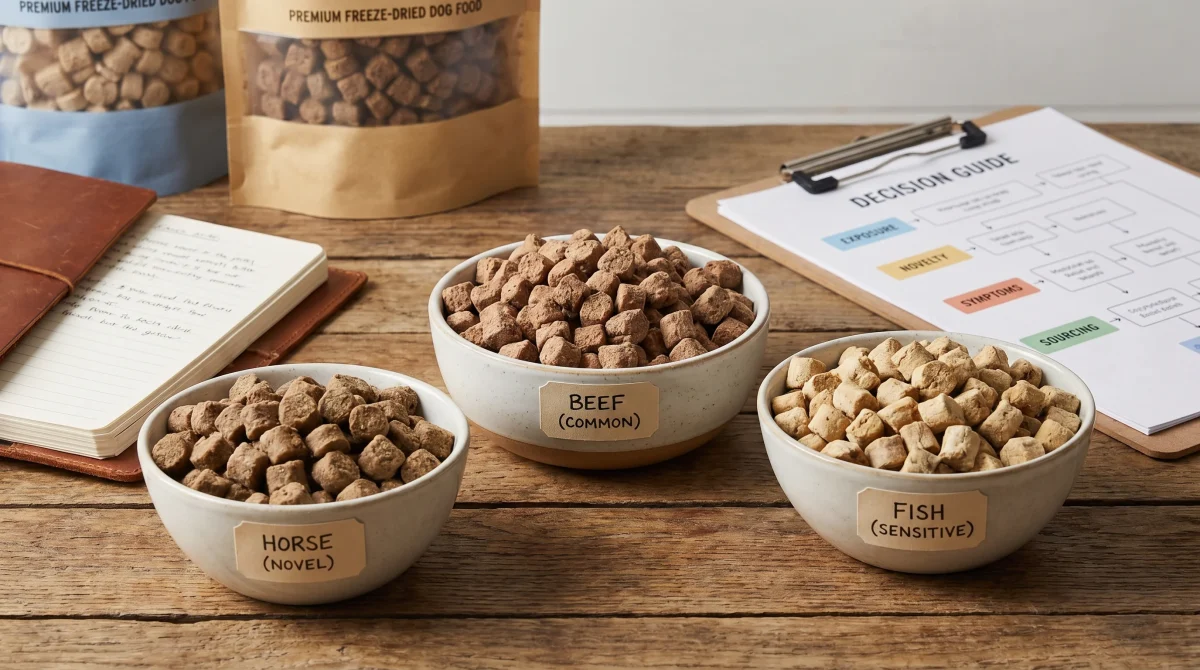
- If your dog has eaten beef, chicken, pork, and fish before, start with horse. In many European homes, horse is a novel protein for dogs.
- If itchy skin dominates and fish is truly novel, consider fish protein for dogs first. Omega‑3s may support skin comfort while you test novelty.
- If you suspect beef allergy in dogs from prior reactions, avoid cattle proteins. Choose horse or fish depending on exposure history.
- If gas and soft stools are frequent, begin with the most novel, lean option your dog will accept. For many households, that is horse or a lean fish.
- If your dog has had fish oil regularly, fish may not be fully novel. Choose horse for a cleaner test.
- If sourcing horse is hard, and beef is truly novel for your dog, a beef single-protein can work. Confirm zero prior exposure first.
- If palatability is a concern, trial whichever of horse, beef, or fish your dog will reliably eat, prioritizing the most novel option.
How to swap if the first choice underperforms
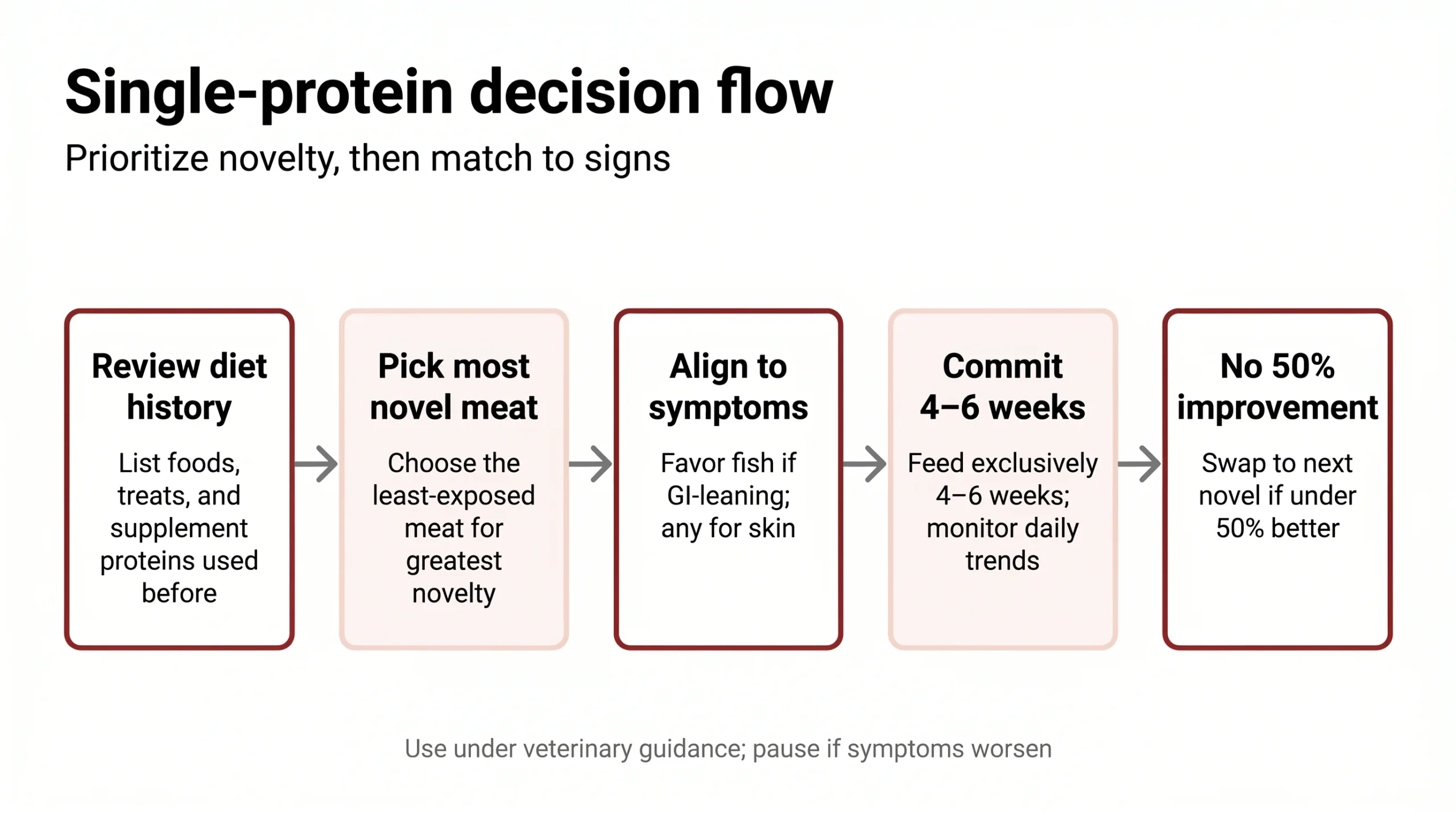
Give the first protein a fair window unless symptoms worsen. If there is no improvement by weeks 4–6, plan a clean swap to the next most novel option. Transition over 48–72 hours, avoid mixing proteins long-term, and reset your monitoring clock.
How horse, beef, and fish differ for allergic dogs
Exposure and novelty likelihood
Beef is frequently fed and appears in many treats. It is often not novel. Horse is far less common in many European diets, so it may deliver novelty. Fish varies by household, because many dogs have had salmon oil or fish-based kibbles. Evidence suggests the success of a trial leans more on novelty and tight control than on a universally “hypoallergenic” protein. Serum tests for food allergens can be difficult to interpret, because both allergic and non-allergic dogs may show IgE/IgG responses to dietary antigens.[4]
Skin vs GI presentation: what evidence suggests
Cutaneous adverse food reactions and gastrointestinal signs may both respond to elimination diets. Dogs with skin disease often require several weeks to show meaningful improvement. GI responses, like stool quality, may shift earlier. Elimination remains the recommended approach to confirm or refute dietary triggers.[1]
Sourcing, processing, and cross-contact considerations
Choose products with transparent ingredient lists and dedicated single-protein processing when possible. Cross-contact can occur if multiple proteins share equipment. For horse options, some guardians find Everfresh Freez-Dried food – Horse 500g practical for maintaining a novel, complete single-protein baseline. Also consider species relatedness. Cross-reactivity can occur among similar proteins; for example, multiple chicken allergens have been identified in sensitized dogs, reminding us that specific protein components may drive reactions.[3]
Monitoring guidance: what to watch after 7–14 days and 4–8 weeks
Short-term signals (week 1–2)
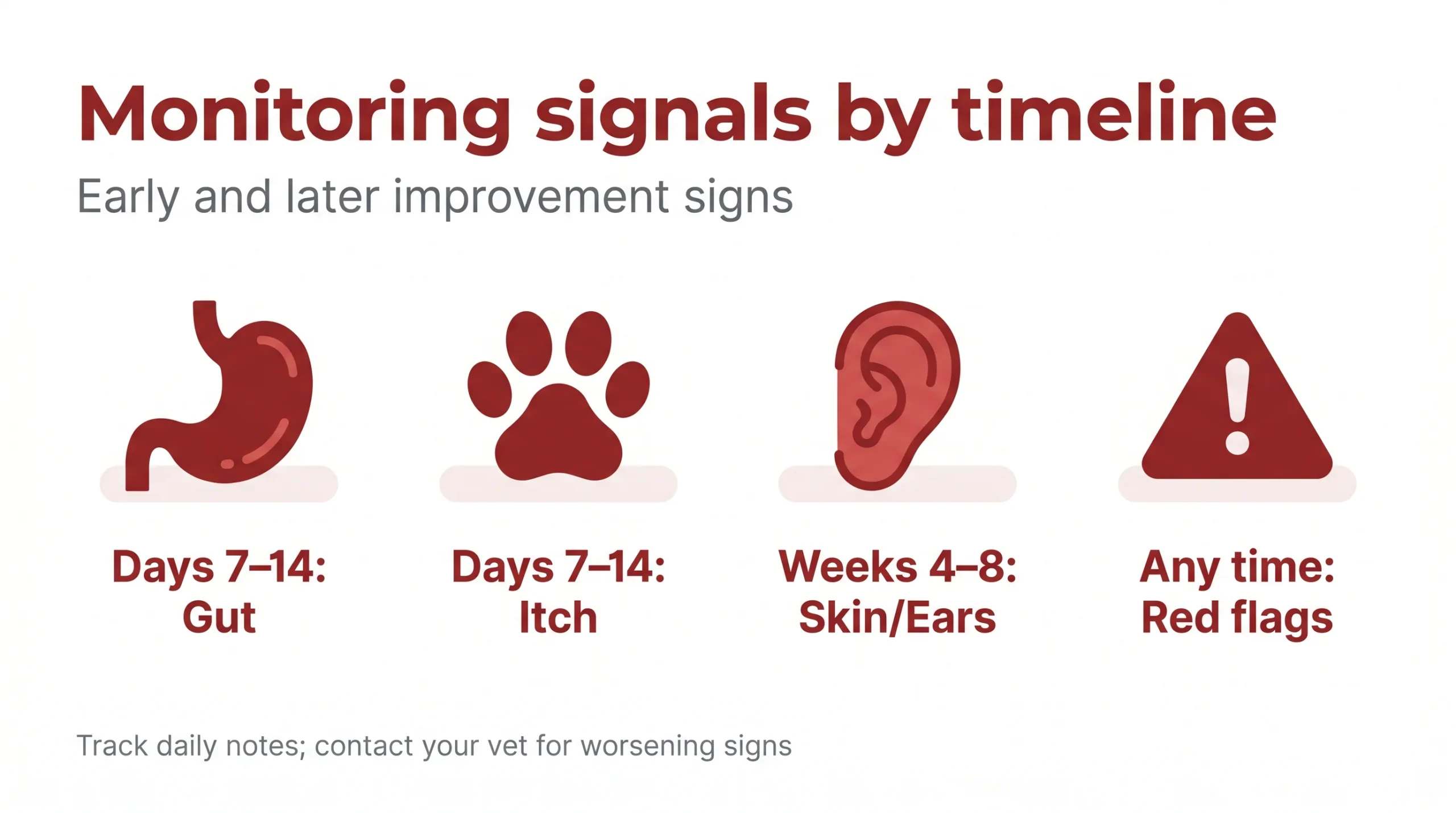
During days 7–14, look for earlier stools, less gas, and a small drop in itch minutes per day. Ear debris may slow. Any vomiting, worsening diarrhea, or refusal to eat signals a poor fit and warrants a reassessment.[1]
Medium window (weeks 4–8) and decision checkpoints
By weeks 4–8, aim for a clear trend: less paw licking, calmer nights, and improved ear odor. If improvement reaches roughly 50% or more, continue. If flat or worse by week 6, prepare a clean swap to the next most novel protein.
Tracking template: stool, itch, ears, hotspots, weight
Use a simple daily log:
- Stool quality: 1–5 scale, with 3 as ideal.
- Itch minutes per day: track actual time.
- Ears: odor, discharge, redness (0–3 each).
- Hotspots: number and size notes.
- Weight: weekly, to ensure stable intake.
Practical safety boundaries
Portioning, rehydration, and fat tolerance
Follow the product’s feeding guide and adjust by body condition. When using freeze-dried meals, rehydrate fully for better digestion and satiety. Start with a modest water-to-food ratio and adjust for stool quality. For detailed rehydration and handling tips, see our travel-safe freeze‑dried guidance. If your dog is prone to pancreatitis or has low fat tolerance, choose lean cuts and monitor closely.
When to pause and seek veterinary input
Pause the trial and contact your vet if there is persistent vomiting, blood in stool, rapid weight loss, spreading skin infection, or lethargy. For structured guidance on urgent signs, read when to see the vet for suspected food allergies.
Supplements that may help without masking responses
Keep extras minimal to preserve clarity. If itch is high and fish is not your trial protein, a modest dose of omega‑3 from algae may support skin comfort without adding a new animal protein. Simple probiotics or plain fiber can support stools. Avoid flavored chews and complex blends during the core trial window.
Evidence status and what we can (and cannot) claim
What clinical literature supports
Elimination and rechallenge remain the most reliable ways to identify food triggers in dogs. Many dogs with food-related skin disease improve on a controlled diet, and time-to-improvement can vary by sign and severity.[1] Laboratory measures of serum IgE/IgG to food proteins show responses in both allergic and non-allergic dogs, limiting their diagnostic certainty.[4]
Where data are limited or mixed
Claims that one meat is “hypoallergenic” for all dogs are not supported. Novelty appears more important than the specific species. Identification of individual allergens in chicken illustrates protein‑component complexity, but does not rank meats by universal safety.[3] Novel proteins, including insects, can still elicit immune responses in sensitized dogs.[2]
How to interpret improvements during an elimination
If signs improve, the working hypothesis is that dietary protein was a contributor. To confirm, a controlled rechallenge is needed. If no improvement occurs, either the protein is not the issue, or hidden exposures confounded your trial.[1]
How this ties into a full elimination plan
Keeping the diet truly single-protein
Consistency wins. Use only the chosen meat and a compatible base. Read every label, including treats and supplements. Multi-protein exposure resets your clock. See our guide on label reading for allergic dogs to prevent accidental slips.
Rechallenge logic after improvement
After a clear improvement, reintroduce the suspected trigger under supervision to confirm cause-and-effect. Add one element at a time, and track responses for several days. For a structured schedule, see food reintroduction after elimination.
Next steps if all three proteins fail
If horse, beef, and fish all underperform, consider a different novel protein, a hydrolyzed diet, or a veterinary dermatology referral. For a step-by-step elimination structure, revisit our 6–8 week elimination plan and assess for hidden exposures or transition issues.

Related resources
See the main guide to food allergies in dogs for full framework
For a complete decision tree, differential signs, and escalation points, explore our pillar: Food allergies in dogs: how to recognize, prioritize, and choose a safe path forward.
Ingredient transparency and freeze-dried handling tips
Plan safe meals for trips with our tips on traveling with a food‑allergic dog using freeze‑dried options, and sharpen your label skills with how to spot hidden proteins, binders, and cross‑contact risks.
Frequently Asked Questions
Is horse meat more hypoallergenic than beef or fish for dogs?
Not universally. It is often novel in Europe, so dogs have had less prior exposure, which may reduce reactions. Individual history matters; evidence suggests novelty helps more than any single protein being categorically superior.
How long should I trial a single-protein diet for dog allergies?
Many elimination trials run 6–8 weeks. You may see early signals in 7–14 days, but meaningful skin improvements often require several weeks. Keep the diet strictly single-protein during this time.
Which is better for itchy skin: fish vs horse?
Fish may support skin due to omega‑3 content, which can modulate inflammation. However, if fish has been fed before, novelty may be lost. Choose based on exposure history first, then consider omega‑3 benefits.
Can I give treats during a single-protein elimination?
Only if they are the exact same single protein and free from cross-contact. Even small additions of other proteins may confound results.
What if symptoms worsen on the first protein?
Stop and reassess. Check for hidden ingredients or cross-contact, then switch to the most novel option remaining. Seek veterinary input if there are severe GI signs, skin infection, or weight loss.
Conclusion
Picking the right single protein is simpler with a plan. Start with the most novel option your dog will happily eat, then monitor clearly and swap if needed. Use careful sourcing, strict control, and honest tracking to reveal patterns. With patience and a tidy process, you can move from uncertainty to insight, and give your dog a calmer gut and more comfortable skin—one protein at a time.
References
- HA Jackson (2023). Food allergy in dogs and cats; current perspectives on etiology, diagnosis, and management. Journal of the American Veterinary Medical …. View article
- B Premrov Bajuk et al. (2021). Insect protein-based diet as potential risk of allergy in dogs. Animals. View article
- T Olivry et al. (2022). Identification of major and minor chicken allergens in dogs. Veterinary …. View article
- CM Pucheu‐Haston et al. (2020). Serum IgE and IgG responses to dietary antigens in dogs with and without cutaneous adverse food reactions. Veterinary dermatology. View article